Tuesday, 29 September 2015

Joke picked from a post


अजमेर शरीफ के दरगाह की सच्चाई:-
अजमेर रेलवे स्टेशन के प्लेटफार्म पर इतनी भीड़ थी कि वहाँ की कोई बैंच खाली न हीं थी। एक बैंच पर एक परिवार, जो पहनावे से हिन्दू लग रहा था, के साथ बुर्के में एक अधेड़ सुसभ्य महिला बैठी थी।
बहुत देर चुपचाप बैठने के बाद बुर्खे में भेठी महिला ने बगल में बैठे युवक से पूछा, "अजमेर के रहनेवाले हैँ या फिर यहाँ घूमने आये हैं?"
युवक ने बताया, "जी अपने माता पिता के साथ पुष्कर में ब्रह्मा जी के मंदिर के दर्शन करने आया था।"
महिला ने बुरा मुँह बनाते हुए फिर पूछा,"आप लोग अजमेर शरीफ की दरगाह पर नहीं गये?"
युवक ने उस महिला से प्रतिउत्तर कर दिया, "क्या आप ब्रह्मा जी के मंदिर गयी थीं?"
महिला अपने मुँह को और बुरा बनाते हुये बोली, "लाहौल विला कुव्वत। इस्लाम में बुतपरस्ती हराम है और आप पूछ रहे हैं कि ब्रह्मा के मंदिर में गयी थी।"
युवक झल्लाकर बोला, "जब आप ब्रह्मा जी के मंदिर में जाना हराम मानती हैं तो हम क्यों अजमेर शरीफ की दरगाह पर जाकर अपना माथा फोड़ें।"
महिला युवक की माँ से शिकायती लहजे में बोली, "देखिये बहन जी। आपका लड़का तो बड़ा बदतमीज है। ऐसी मजहबी कट्टरता की वजह से ही तो हमारी कौमी एकता में फूट पड़ती है।"
युवक की माँ मुस्काते हुये बोली, "ठीक कहा बहन जी। कौमी एकता का ठेका तो हम हिन्दुओं ने ही ले रखा है।
अगर हर हिँदू माँ-बाप अपने बच्चों को बताए कि अजमेर दरगाह वाले ख्वाजा मोईनुद्दीन चिश्ती ने किस तरह इस्लाम कबूल ना करने पर पृथ्वीराज चौहान की पत्नी संयोगिता को मुस्लिम सैनिकों के बीच बलात्कार करने के लिए निर्वस्त्र करके फेँक दिया था और फिर किस तरह पृथ्वीराज चौहान की वीर पुत्रियों ने आत्मघाती बनकर मोइनुद्दीन चिश्ती को 72 हूरों के पास भेजा था तो शायद ही कोई हिँदू उस मुल्ले की कब्र पर माथा पटकने जाए। पृथ्वीराज चौहान गोरी को १७ बार युद्ध में हराने के बाद भी उसे छोड़ देता है जबकि एक बार उस से हारने पर चौहान के आँख फोड़ के बेरहमी से मार कर उसके शव को घसीटते हुए अफ़ग़ानिस्तान ले गया और दफ़्न किया। आज भी चौहान के क़ब्र पर जो भी मुसलमान वहॉ जाता है प्रचलन के अनुसार उनके क़ब्र को वहॉ पे रखे जूते से मारता है। ऐसी बर्बरता कहीं नहीं देखी होगी। फिरभी हम हैं कि ......,
"अजमेर के ख्वाजा मुइनुद्दीन चिश्ती को ९० लाख हिंदुओं को इस्लाम में लाने का गौरव प्राप्त है. मोइनुद्दीन चिश्ती ने ही मोहम्मद गोरी को भारत लूटने के लिए उकसाया और आमंत्रित किया था...
(सन्दर्भ - उर्दू अखबार
"पाक एक्सप्रेस, न्यूयार्क १४ मई २०१२).

Friday, 25 September 2015

Sikhism(India)

Sikhism is India's fourth-largest religion and has existed for 546 years, beginning with the birth of its founder Guru Nanak. The Sikhs are predominantly located in Punjab, but also in many other parts of India. It is also the fifth largest religion in the world with 25 million followers in the world as of year 2010.

Prominent Sikhs in India

Though Sikhs are a small minority in India, the community occupies a significant place in the country. The past Prime Minister of India, Dr. Manmohan Singh is a Sikh, as is former President of India Giani Zail Singh. Almost every council of ministers in India has included Sikh representatives. Sikhs are also conspicuous in the Indian army, primarily because they formed the sword arm of the British empire. The only living Indian officer with a 5 star rank Arjan Singh is a Sikh. Sikhs have also led the Indian army through JJ Singh and the Indian Air Force was led by Air Chief Marshal Dilbagh Singh. Sikhs have been prominent in Indian sports, with the only Indian gold medalist in Olympics, Abhinav Bindra, being a Sikh. Similarly they occupy important official positions, like Deputy Chairman of the Planning Commission, Montek Singh Ahluwalia; governor Surjit Singh Barnala. Sikhs are also known for entrepreneurial business in India. In the entertainment industry, singer Daler Mehndi and Rabbi Shergill are Sikhs. One reason for visibility of Sikhs in the Indian spectrum is the disproportionate role played by the Sikh community during the Indian freedom struggle, with Bhagat Singh remaining a youth icon to Indian youth.
Gurdwara Bangla Sahib
A Sikh place of worship is called Gurdwara. Sikhism does not support pilgrimage to holy sites because according to Sikhism, God is everywhere and not in any certain place. The Harmandir Sahib in Amritsar in Punjab is a prominent Sikh Gurdwara.

Langar (the communal meal)

Sikhism emphasises community services and helping the needy. One of the distinct features of Sikhism is the common kitchen called Langar. In every Gurdwara there is a Langar . Every Sikh is supposed to contribute in preparing a communal meal in the free kitchen. The meals are served to all and are eaten sitting on the floor. Sikhism does not believe in holding fasts, for the body is God's present to the human being; and therefore humans must foster, maintain and preserve it in good, sound condition, unless fasting is done to foster the human body like healthy diets.

The Guru Granth Sahib

Guru Nanak was the founder of Sikhism and the first Sikh Guru. The last Guru, Guru Gobind Singh passed the Guruship of the Sikhs to the Eleventh and Eternal Guru of the Sikhs, the Guru Granth Sahib (the sacred text of Sikhism). It also includes the writings of the Sikh Gurus and the writings of Hindu and Muslims saints because all are equal in front of Waheguru.  Sikhism is derived from Hinduism but in reality these both are totally different religions. Only language matches somewhere but meaning and teachings of Shri Guru Granth Sahib Ji is completely different from Hinduism. Sikhs do not believe in idols and other rituals, they only believe in one god i.e. Waheguru.
Guru Granth Sahib Ji clearly states that-
ਪੂਜਾ ਕਰਉ ਨ ਨਿਵਾਜ ਗੁਜਾਰਉ॥ ਏਕ ਨਿਰੰਕਾਰ ਲੇ ਰਿਦੈ ਨਮਸਕਾਰਉ॥੩॥
I do not perform Hindu worship services, nor do I offer the other prayers. I have taken the One Formless Lord into my heart; I humbly worship Him there. ||3||
ਨਾ ਹਮ ਹਿੰਦੂ ਨ ਮੁਸਲਮਾਨ॥ ਅਲਹ ਰਾਮ ਕੇ ਪਿੰਡੁ ਪਰਾਨ॥੪॥
I am neither a Hindu, nor am I a from any other religion. My body and breath of life belong to the Great Almighty 
Guru Gobind Singh Ji declared in the verses of Uggardanti:
ਦੁਹੂੰ ਪੰਥ ਮੈਂ ਕਪਟ ਵਿੱਦਯਾ ਚਲਾਨੀ॥ ਬਹੁੜ ਤੀਸਰਾ ਪੰਥ ਕੀਜੈ ਪਰਧਾਨੀ॥
Tho two paths (Vedic and Abrahamic) have become corrupt. O' Lord propagate and uplift the third path (Khalsa Panth).

Sikhs combat with the Mughals

Guru Tegh Bahadur Ji on the request of Kashmiri Pandits saved whole Hindu community from conversion to Muslim religion by giving sacrifice. He is called Hind di Chadar (Saviour of Hindu Religion). Aurungzeb's religious policy was totally against Hindus, they had to pay more taxes than Muslims. Sir Mohd. Latif writes "He discouraged the teaching of the Hindus, burnt to the ground the great Pagoda near Delhi, and destroyed the temple of Bishnath at Benares, and the great temple of Dera Kesu rai at Mathura, said to have been built by Raja Narsingh deo, at the cost of 33 lakh rupees. The gilded domes of this temple were so high that they could be seen from Agra 54 km distant. On the site of temple he built a mosque at a great cost. About year 1690, the emperor issued an edict prohibiting Hindus from being carried in palanquins or riding on Arabian horses.
Khalsa Panth (Punjabi: ਖਾਲਸਾ ਪੰਥ khĝlsĝ panth) meaning: the worldwide community of Khalsa or Sikhs generally (baptised Sikhs are called "Khalsa"). It is a name given to the religious structure and the community that manages the affairs of the global Khalsa community. "Khalsa" refers to the entire group of people who have taken an active decision to follow the way of life laid down by Guru Gobind Singh, the tenth Sikh Guru; it is the way of the life managed by the Khalsa community, who are self-managed through their democratic and collective wishes. Since Vaisakhi 1699 when the Khalsa was first forged, this community has existed as a distinct group; completely involved in their own local societies but also aware of its social and spiritual responsibility as stipulated by the tenth master. Unlike, other societies, this group did not lay claim to territory or land and property, even when they had rightfully defeated their aggressive opponents. The Panth's aim are the same as that of Sikhi in general and one is just the distillation of the other. The Panth has always existed as a community within other social groups. So, you have had panthic members living as Khalsa in locations away from Punjab where the Khalsa was originally created. Today, you will find the Khalsa located in almost all the major countries of the world; living in harmony with their local societies but always aware of the underlying requirements of their spiritual masters.

Creating an identity for the Sikhs

Kanga, Kara and Kirpan—three of the five articles of faith endowed to the Sikhs.
Kesh: (Kesh is uncut hair) A Sikh is to maintain and adorn this natural God-given gift. To work with nature and not against it. The Kesh was covered with a turban, Keski or Chunni to keep it clean and manageable. The keski is regarded by some the kakkar instead of kesh.
Kanga (wooden comb) for the maintenance and ongoing upkeep of Kesh. A reminder to regularly maintain the body and mind in a clean and healthy state.
Kara (steel bracelet or slave bangle): Symbolises an unbreakable bond with God. It is a constant reminder that the Sikh is a slave of the Lord. He or she must only do His work in accordance with the Holy Scripture; to abstain for wrongdoing at all times.
Kachhera (cotton underwear) Standard, Naturally Comfortable, dignified attire reflective of modesty and control. A sign of a soldier; ever ready; dignified and highly mobile.
Kirpan (a small sword) A sign that a Sikh is a soldier in "Akal Purakh's (God's) Army" (Akal Purakh de fauj); to maintain and protect the weak and needy and for self-defence. Never to be used in anger. 

Asha Ram we call him Bapu ( Saint or a mokaparast Vyapari)

Y sabhi personal vichar h kisi ki bhwnao ko ahat krna hamara udeshay nhi h. Hm keval prayas ker rhe h galat ko galat or sahi ko sahi dhang se samjhne ka.


Y news ajkal bhut khabaro m rhti h ki Asharam ke khilaf case ke jo gawah h un per hamle ho rhe h or kuch ki jaan bhi le li gyi h.

 Pahle mera dhyan is oor nhi jata tha na hi mane kabhi dhyan diya is baat pr. M bhi sochta rha ki ho skta h ki y sab rajnitik chal ho skkti h Asharam bapu ke khilaf. Mujhe gyan nhi h is baat ka ki akhir sachayi kya h na hi abhi tk kuch sabit hua h janch chal rhi h or faisla ana abhi baki h. 

Pr m sochne pr majboor ho jata hu ki agar Asharam Bapu doshi h to kya use doshi saabit krna possible ho payega is tarah se ( sare gawaho ki jaan ja rhi h bari bari or un per hamle ho rhe h).

 M abhi kuch dino ke liye visit pr gaya hua tha or hum abhi hotel m phuch kr aram kr rhe the ki tabhi mane TV per news dekhi ki ek or Gawah ko jaan se mar diya gya

In halato ko dekh kr m sochne ke liye majboor ho gya ki hum sadharan ya phir kahe ki aam adami ki jindagi itni sasti kaise ho gyi or kon  h y asharam. Or kyu hamari sarkarein in gawaho ko suraksha nhi de pati or koi bhi akar in logo ki jaan le kr nikal jata h itne asani se, Akhir kyu h aisa.

 Kya aam aadmi ki value keval vote dene tak hi h or kyu jaan le li jati h aam aadmi ki bhale hi  use security bhi uplabdh ho???????.

 Kya koi karyawahi hoti h in police walon per jo apne kam ko shi se anjaam nhi dete?????.
 Kya aisa tab bhi hota h jab ek VIP ki hatya kr di jaye???. Kyu enquiry kri jati h tab???. Akhir y VIP hota kya h???. Kya hota h y very important person???. Kya hr aadmi ki life kisi na kisi se nhi judi hoti??? kya vo aadmi important nhi h un logo ke liye???
 AAge bhadhte hue ek image hamne di h reference ke liye.
Kya y koshish nhi h ek shatir insaan ki logo ko bharmit krne ki. Apne ap ko bhagwan ki tarah se pracharit krna jisse y bholi janta prabhavit hoti h.
 Kya y khule aam hone wali dhokebaji nhi h??

                                                                          Continued.......


Thursday, 24 September 2015

Inspiration for the Day


A small child standing in his hands was an Apple,
 her father gleefully said "Give me an Apple Son"
 hear this kid  take a bite from one Apple.
Find her father speaking anything prior to that he took another apple and started biting it from his  teeth  Apple .Seeing this smile on Daddy's face  vanished ...
Then After a Second Boy  forward his hand with one apple in it and said . ...
"Daddy's take this one . This is  more sweet.
 Sometimes  we arrive at conclusions without knowing the whole thing .
Some one has written a beautiful line : It is possible to operate an eye but not the thinking,this is the whole difference.
Otherwise, the same  staircases go above and , and comes down too.


Hindi Version:---
एक छोटा सा बच्चा अपने दोनों हाथों में एक एक एप्पल लेकर खड़ा था
उसके पापा ने मुस्कराते हुए कहा कि
"बेटा एक एप्पल मुझे दे दो"
इतना सुनते ही उस बच्चे ने एक एप्पल को दांतो से कुतर
लिया.
उसके पापा कुछ बोल पाते उसके पहले ही उसने अपने दूसरे
एप्पल को भी दांतों से कुतर लिया
अपने छोटे से बेटे की इस हरकत को देखकर बाप ठगा सा रह
गया और उसके चेहरे पर मुस्कान गायब हो गई थी...
तभी उसके बेटे ने अपने नन्हे हाथ आगे की
ओर बढाते हुए पापा को कहा....
"पापा ये लो.. ये वाला ज्यादा मीठा है.
शायद हम कभी कभी पूरी बात जाने
बिना निष्कर्ष पर पहुंच जाते हैं..
किसी ने क्या खूब लिखा है:
नजर का आपरेशन
तो सम्भव है,
पर नजरिये का नही..!!! 💯
फर्क सिर्फ सोच का
होता है.....
वरना , वही सीढ़ियां ऊपर भी
जाती है ,और नीचे भी
आती है

Friday, 18 September 2015

Learn to Meditate

Learn to Meditate


Subscribe to our page to get regular updates from Guru AAdiSHIV.
If you feel any doubt then please contact and leave comment.

  •  Sit Comfortably, you can sit in any suitable posture  (But the most Benificial posture is to sit in Padmasan as shown in the image above.
  • Before going into the meditation phase you need to calm down your body and your thoughts. For doing this start inhale and exhale with some little extra effort, it will make your body to soak more oxygen and calm your mind and thoughts respectively.
  • Now you will feel calm and in peace.
  • One more thing to notice:- Inhale through your nostril and exhale through your mouth.
  • Now close your eyes and start inhale and exhale without extra effort ( note:- Please don't involve any extra efforts while inhaling and exhaling during this process)
  • You should focus on  inhale and exhale.
  • Do not bother when you reach this step after completing all the steps who will automatically be able to concentrate on inhale and exhale.
Note:- Inhale through your nostrils and exhale through your mouth.

Learn Meditation (Simplest Way)

 
Meditation is an approach to training the mind, similar to the way that fitness is an approach to training the body. But many meditation techniques exist. So how do you learn how to meditate????????????.
That is a very big question. I have searched a lot about this technique but did not get satisfied by any of the solution provided.
There are some asking for the payments and some are forcing us to search here and there.
But nothing productive has been given about Meditation.

Nothing special has to be done by you here.
Just click the link given:-Learn Meditation (Simplest Way)

Mohammad -The Prophet

                                                        Muhammad

Muhammad( 570- 8 june 632) full name is Abū al-Qāsim Muḥammad ibn ʿAbd Allāh ibn ʿAbd al-Muṭṭalib ibn Hāshim. He was the Father of Qasim Muhammad  and the son of Abd Allah s/o Abdul-Muttalib s/o Hashim).He belongs  from Mecca, unified Arabia into a single religious polity under Islam.

Believed by Muslims and Bahá'ís to be a prophet and messenger of God. Muhammad is almost universally considered by Muslims as the last prophet sent by God to mankind. While non-Muslims generally regard Muhammad as the founder of Islam, Muslims consider him to have restored the unaltered original monotheistic faith of Adam, Abraham, Moses, Jesus, and other prophets.

He born in 570 CE in Arabian city of MECCA. This is the reason MECCA has been considered so sacred in the life of a muslim.
And it remains a last goal of almost every muslim to visit the MECCA at least once.

One thing is important here that according to muslim he was considered  as a prophet of God who restored the unaltered original faith of Jesus and other phrophets.

Muhammad was orphaned at an early age. He was raised under the care of his paternal uncle Abu Talib.
Muhammad primarily worked as a merchant.
Occasanally he would retreat to a cave in a mountain for several nights of seclusion and prayer.
Later at the age of 40 he himself reported that he has received his first revelation from God.
Then he started preaching these revelations.
He proclaimed that God is One. As any other religion in this world preaches. And Ahimsa is the eternal truth by God.
 

Thursday, 17 September 2015

Hinduism - 2

The word Hindu is derived from the Indo-Aryan /Sanskrit word Sindhu, the Indo-Aryan name for the Indus River in the northwestern part of the Indian subcontinent (modern day Pakistan and Northern India). According to Gavin Flood, "The actual term 'hindu' first occurs as a Persian geographical term for the people who lived beyond the river Indus (Sanskrit: Sindhu)", more specifically in the 6th-century BCE inscription of Darius I.The term 'Hindu' in these ancient records is a geographical term and did not refer to a religion.[19] Among the earliest known records of 'Hindu' with connotations of religion may be in the 7th-century CE Chinese text Record of the Western Regions by Xuanzang,and 14th-century Persian text Futuhu's-salatin by 'Abd al-Malik Isami.
Thapar states that the word Hindu is found as heptahindu in Avesta – equivalent to Rigvedic sapta sindhu, while hndstn (pronounced Hindustan) is found in a Sasanian inscription from the 3rd century CE, both of which refer to parts of northwestern South Asia. The Arabic term al-Hind referred to the people who live across the River Indus.This Arabic term was itself taken from the pre-Islamic Persian term Hindū, which refers to all Indians. By the 13th century, Hindustan emerged as a popular alternative name of India, meaning the "land of Hindus".
The term Hindu was later used occasionally in some Sanskrit texts such as the later Rajataranginis of Kashmir (Hinduka, c. 1450) and some 16th- to 18th-century Bengali Gaudiya Vaishnava texts including Chaitanya Charitamrita and Chaitanya Bhagavata. These texts used it to contrast Hindus from Muslims who are calledYavanas (foreigners) or Mlecchas (barbarians), with the 16th-century Chaitanya Charitamrita text and the 17th century Bhakta Mala text using the phrase "Hindudharma". It was only towards the end of the 18th century that European merchants and colonists began to refer to the followers of Indian religions collectively as Hindus. The term Hinduism was introduced into the English language in the 19th century to denote the religious, philosophical, and cultural traditions native to India.

Definitions

The study of India and its cultures and religions, and the definition of "Hinduism", has been shaped by the interests of colonialism and by Western notions of religion. Since the 1990s, those influences and its outcomes have been the topic of debate among scholars of Hinduism, and have also been taken over by critics of the Western view on India.
Hinduism includes a diversity of ideas on spirituality and traditions, but has no ecclesiastical order, no unquestionable religious authorities, no governing body, no prophet(s) nor any binding holy book; Hindus can choose to be polytheistic, pantheistic, monotheistic, monistic, agnostic, atheistic or humanist. Because of the wide range of traditions and ideas covered by the term Hinduism, arriving at a comprehensive definition is difficult. The religion "defies our desire to define and categorize it". Hinduism has been variously defined as a religion, a religious tradition, a set of religious beliefs, and "a way of life."From a Western lexical standpoint, Hinduism like other faiths is appropriately referred to as a religion. In India the term dharma is preferred, which is broader than the western term "religion". Hindu traditionalists prefer to call it Sanatana Dharma (the eternal or ancient dharma).

Colonial influences


The notion of common denominators for several religions and traditions of India was already noted from the 12th century CE on.The notion and reports on "Hinduism" as a "single world religious tradition" was popularised by 19th-century proselytizing missionaries and European Indologists, roles sometimes served by the same person, who relied on texts preserved by Brahmins (priests) for their information of Indian religions, and animist observations which the missionary Orientalists presumed was Hinduism. These reports influenced perceptions about Hinduism. Some scholars state that the colonial polemical reports led to fabricated stereotypes where Hinduism was mere mystic paganism devoted to the service of devils, while other scholars state that the colonial constructions influenced the belief that the VedasBhagavad GitaManusmriti and such texts were the essence of Hindu religiosity, and in the modern association of 'Hindu doctrine' with the schools of Vedanta (in particular Advaita Vedanta) as paradigmatic example of Hinduism's mystical nature".Pennington, while concurring that the study of Hinduism as a world religion began in the colonial era, disagrees that Hinduism is a colonial European era invention.[53] He states that the shared theology, common ritual grammar and way of life of those who identify themselves as Hindus is traceable to ancient times.

Indigenous understanding

Sanātana Dharma


To its adherents, Hinduism is a traditional way of life. Many practitioners refer to Hinduism as Sanātana Dharma, "the eternal law" or the "eternal way". It refers to the "eternal" duties all Hindus have to follow, regardless of class, caste, or sect, such as honesty, refraining from injuring living beings, purity, goodwill, mercy, patience, forbearance, self-restraint, generosity, and asceticism. This is contrasted with svadharma, one's "own duty", the duties to be followed by members of a specific caste and stage of life. According to Knott, this also
... refers to the idea that its origins lie beyond human history, and its truths have been divinely revealed (shruti) and passed down through the ages to the present day in the most ancient of the world's scriptures, the Veda. (Knott 1998, p. 5)
According to the Encyclopædia Britannica;-
The term has also more recently been used by Hindu leaders, reformers, and nationalists to refer to Hinduism as a unified world religion. Sanatana dharma has thus become a synonym for the "eternal" truth and teachings of Hinduism, the latter conceived of as not only transcendent of history and unchanging but also as indivisible and ultimately nonsectarian.
The Sanskrit word dharma has a much deeper meaning than religion and is not its equivalent. All aspects of a Hindu life, namely acquiring wealth (Artha), fulfillment of desires (kama), and attaining liberation (moksha) are part of dharma which encapsulates the "right way of living" and eternal harmonious principles in their fulfillment.

Growing Hindu identity

This sense of unity and ancientness has been developed over a longer period. According to Nicholson, already between the 12th and the 16th centuries "certain thinkers began to treat as a single whole the diverse philosophical teachings of the Upanishads, epics, Puranas, and the schools known retrospectively as the "six systems" (saddarsana) of mainstream Hindu philosophy. The tendency of "a blurring of philosophical distinctions" has also been noted by Burley. Hacker called this "inclusivism" and Michaels speaks of "the identificatory habit". Lorenzen locates the origins of a distinct Hindu identity in the interaction between Muslims and Hindus, and a process of "mutual self-definition with a contrasting Muslim other", which started well before 1800. Michaels notes:
As a counteraction to Islamic supremacy and as part of the continuing process of regionalization, two religious innovations developed in the Hindu religions: the formation of sects and a historicization which preceded later nationalism [...] [S]aints and sometimes militant sect leaders, such as the Marathi poet Tukaram (1609-1649) and Ramdas (1608-1681), articulated ideas in which they glorified Hinduism and the past. The Brahmins also produced increasingly historical texts, especially eulogies and chronicles of sacred sites (Mahatmyas), or developed a reflexive passion for collecting and compiling extensive collections of quotations on various subjects.[70]
This inclusivism was further developed in the 19th and 20th centuries by Hindu reform movements and Neo-Vedanta,and has become characteristic of modern Hinduism.

Hindu modernism
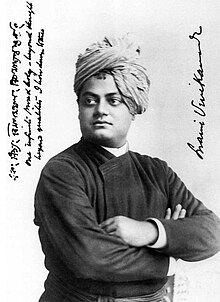
Swami Vivekananda was a key figure in introducing Vedanta and Yoga in Europe and USA, raising interfaith awareness and making Hinduism a world religion.

Beginning in the 19th century, Indian modernists re-asserted Hinduism as a major asset of Indian civilisation, meanwhile "purifying" Hinduism from its Tantric elements and elevating the Vedic elements. Western stereotypes were reversed, emphasizing the universal aspects, and introducing modern approaches of social problems. This approach had a great appeal, not only in India, but also in the west.Major representatives of "Hindu modernism"are Raja Rammohan Roy,VivekanandaSarvepalli Radhakrishnan and Mahatma Gandhi.
Raja Rammohan Roy is known as the father of the Hindu Renaissance. He was a major influence on Swami Vivekananda (1863-1902), who, according to Flood, was "a figure of great importance in the development of a modern Hindu self-understanding and in formulating the West's view of Hinduism." Central to his philosophy is the idea that the divine exists in all beings, that all human beings can achieve union with this "innate divinity", and that seeing this divine as the essence of others will further love and social harmony. According to Vivekananda, there is an essential unity to Hinduism, which underlies the diversity of its many forms. According to Flood, Vivekananda's vision of Hinduism "is one generally accepted by most English-speaking middle-class Hindus today."
Sarvepalli Radhakrishnan was "one of India's most erudite scholars to engage with western and Indian philosophy". He sought to reconcile western rationalism with Hinduism, "presenting Hinduism as an essentially rationalistic and humanistic religious experience." This "Global Hinduism" has a worldwide appeal, transcending national boundaries and, according to Flood, "becoming a world religion alongside Christianity, Islam and Buddhism", both for the Hindu diaspora communities and for westerners who are attracted to non-western cultures and religions. It emphasizes universal spiritual values such as social justice, peace and "the spiritual transformation of humanity." It has developed partly due to "re-enculturation", or the Pizza effect, in which elements of Hindu culture have been exported to the West, gaining popularity there, and as a consequence also gained greater popularity in India.[85] This globalization of Hindu culture was initiated by Swami Vivekananda and his founding of the Ramakrishna Mission, an effort continued by other teachers, "bringing to the West teachings which have become an important cultural force in western societies, and which in turn have become an important cultural force in India, their place of origin."

Western understanding

Western scholars regard Hinduism as a fusion or synthesis of various Indian cultures and traditions.
Hinduism's tolerance to variations in belief and its broad range of traditions make it difficult to define as a religion according to traditional Western conceptions.
Some academics suggest that Hinduism can be seen as a category with "fuzzy edges" rather than as a well-defined and rigid entity. Some forms of religious expression are central to Hinduism and others, while not as central, still remain within the category. Based on this idea Ferro-Luzzi has developed a 'Prototype Theory approach' to the definition of Hinduism.

Hinduism

Hinduism is the dominant religion, or way of life, in South Asia, most notably in India and Nepal. Although Hinduism contains a broad range of philosophies, it is a family of linked religious cultures bound by shared concepts, recognizable rituals, cosmology, shared textual resources, pilgrimage to sacred sites and the questioning of authority.It includes Shaivism, Vaishnavism and Shaktism among other denominations, each with an interwoven diversity of beliefs and practices. With approximately one billion followers Hinduism is the world's third largest religion, after Christianity and Islam.
Hinduism has been called the "oldest religion" in the world, and some practitioners and scholars refer to it as Sanātana Dharma, "the eternal law" or the "eternal way beyond human origins. Western scholars regard Hinduism as a fusionor synthesis of various Indian cultures and traditions, with diverse roots and no single founder. It prescribes the eternal duties, such as honesty, refraining from injuring living beings , patience, forbearance, self-restraint, compassion, among others.
Prominent themes in Hindu beliefs include (but are not restricted to), the four Puruṣārthas, the proper goals or aims of human life, namely Dharma (ethics/duties), Artha (prosperity/work), Kama (emotions/sexuality) and Moksha(liberation/freedom)karma (action, intent and consequences), samsara (cycle of rebirth), and the various Yogas(paths or practices to attain moksha.Hindu practices include rituals such as puja (worship) and recitations, meditation, family-oriented rites of passage, annual festivals, and occasional pilgrimages. Some Hindus leave their social world and material possessions, then engage in lifelong Sannyasa (ascetic practices) to achieve moksha.
Hindu texts are classified into Shruti ("heard") and Smriti ("remembered"). These texts discuss theologyphilosophy,mythologyVedic yajna and agamic rituals and temple building, among other topics. Major scriptures       include the VedasUpanishads (both Śruti), MahabharataRamayanaBhagavad GitaPuranasManusmṛti, and Agamas (allsmriti).

Wednesday, 16 September 2015

Learn A Little Guru AAdiSHIV


                                            Learn A Little Guru AAdiSHIV

A Real Hero or a Villain
  •  How to live life in the correct way with people who have ego and have jealousy?
                                            A Little About Christianity (ii)

  •  That’s good, thank them! Because they are like that they bring good skills within you. Good people will not be able to bring as much skills in you as wicked ones. Because you have to be careful, you have to use all your skills. With good people you can just sleep.
                                                                                Real Life Heroes               

  •   When we are not able to forget Our past. Our past keeps following me, and this disturbs our            relationship. What should We  do?
                                                    Cuteness for the day 16/9/15
  •   Meditation is the answer. Meditation makes you alive in the present moment, and you feel disconnected    with all that happened in the past. All the old things have dropped off, and you are not the same person    now. Even when you look back and reflect, you will not be able to relate to how you were as a person        before coming to the path. You feel, “Oh, was that really me back then?”    
                                                                                                         story of the day(English) 14/9/2015
     
     Purpose of sound is to lead you back to silence.                                                                                                    Guru AAdiSHIV

                   Supported by the physics rule equal and opposite reaction.

    The source of your mind is love and whatever you do to go                that source is a spiritual practice.                                                                                                       Guru AAdiSHIV
                              Story for the day. 12/9/15

     The more we open ourselves, the more space god have                                            to fill us.                                                                                                             Guru AAdiSHIV

      Examine everything in life and think that is nothing then              what remains in life is love and that is everything.
                                                                                                                                                                                                                                                                                                                                          Guru AAdiSHIV

       Each and every one of you is a spiritual teacher                      consciously or unconsciously, you are teaching.                                                                                                                                                  Guru AAdiSHIV